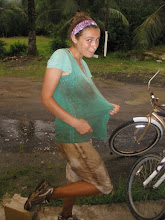
An unexpected perk of having to swim in my clothes so as not to offend anybody with the sight of my thighs is that I am always ready to hop in the water. A floor length skirt feels like the perfect outfit for wading into the ocean for a swim by the dock, and so, en route to our apartments after a day spent sweating in the sun celebrating liberation day, we stopped for a dip to cool down just a bit.
The liberation that is cause for celebration is from Japanese occupation. Basically, we are celebrating American power over the islands instead of former Japanese rule, and it's hard for me to stand behind that. Still held in a compact agreement with the states, the FSM has protectorate status now. It's a country that often refers to the US as the mainland, runs US funding, and has an economy that uses US dollars. It's hard to look at flags waving in celebration, and not wonder if liberation is still yet to come.
Of course, these issues didn't stop me from enjoying the five day weekend where island life stopped so that everyone could play field games, go canoe racing, and march around in circles singing and clapping during all of these activities to keep up team spirit.
The first day's festivities included an agricultural festival held at the harbor in the midst of a pretty fierce storm. I biked down there with a friend, and in the middle of the ride across the causeway, I noted that neither of us were about to turn around. Even though we could barely see. Even though I worried the wind would tip me over and into the harbor. Once we decided we were going to go somewhere, we tended to be too determined/stubborn/stupid to turn around. So, we biked on, drenched with rain, and rusting our hardware store Huffy bicycles just that much faster. Once we made it there, we had to hold onto the tents to stop them from blowing away, and a palm branch flew down and slapped me on the foot, which I kicked away thinking how happy it hadn't been in the face. People were wearing sweatshirts. People own sweatshirts here?
They ended the announcements early since it was hard to hear over the howling wind, and I think we could have lost a couple audience members with all of the tree branches and tent pieces whipping around in the gusts. All of the farmers that showed up quickly tried to sell all of the produce set out across the harbor once the official program ended. I had the privilege of seeing 4 or 5 varieties of coconuts, bananas, and breadfruit, as well as an assortment of pandanas, apples, oranges, and limes. The tricky part was buying. After we had made it this far, we weren't going back empty handed. We picked up fruit,t and held it up, hoping the farmer that had grown it would notice us. No luck, until another volunteer's host brother noticed us looking confused and waving bushels of oranges in the air. He helped us out, helped us buy what we wanted, and then people just started giving things away. It can be hard to buy produce around here. The shops are usually closed, and most of what we get comes from host families. They'll stop by on the way back from a farm further inland, drop off a bushel of bananas or a soursop. The other day I walked into a produce stall, picked up the only bushel of ripe bananas, laid them onto the scale, and pulled out my wallet. "Those are reserved," the kid running the place told me. I know I'm really getting used to how things work in Kosrae when I wasn't even surprised. Of course they were reserved. Why would I be able to just walk in and buy the only ripe bananas, especially without knowing anybody in charge of this particular produce stall? I'm used to finding things in stores, the rare papaya or the last carton of milk and then learning that they are sold, reserved, not for sale. That's shopping in Kosrae.
The first day of festivities was nothing compared to the second. Mondays's celebration was held at an elementary school. Each village is broken up into smaller teams based on the area where each family lives. My host family lived in a part of Lelu village grouped into the Seaside team, so I donned bright green and sat down with bleachers full of fellow Seasiders wearing green t shirts, skirts, and shorts. Gathered there, it was time for field games. Relay races, egg tosses, tire rolling relays. All participants get a bag of laundry detergent or sugar. After every event. Win or lose or stop halfway, you get that bag of Japanese Tide or bag of sugar. After one canoe race, I sat back down in the bleachers without going up to collect a prize. A woman marched up to me, grabbed my hand, and pulled me up to collect some detergent. My three roomates and I came home that afternoon with a bounty, and I'm ready to bake cookies and do laundry for months now.
Apparently all of the celebrating has worn me out. I'm pretty sun burnt; my nose is pink as if I just came in from the cold. It's actually my first sunburn since I got here, the first of many I'll end up with living near the equator. I also finally gave into the cold that I had been fending off during the festivities, and after a day of class, I don't really have a voice. School has been canceled for Friday since so many students are out with the flu, and, because another village has to celebrate liberation day today. It's a good thing, or else I would have lost what squeaky husky excuse for a voice that I have left.
Thursday, September 10, 2009

Saturday, August 29, 2009


Saturday, August 22, 2009
Choir songs and swine, balloons and bubblegum
The road leading up to the new church in Tafunsak is strung along with balloons and a long line of cars, pick-up tracks packed with people in the back. It is a pile up of traffic that I will likely never see again on the island. I take in the scene from the back of my host family's truck, snapping a couple of photos, ducking to avoid palm branches.
After we park and hop out of the truck, we are each handed a tupperware container stuffed with food. Each one has at least two hard boiled eggs, chicken legs, bacon, ham, pork chops, muffins, cake, rice, breadfruit. Towels tied with ribbon into wreaths are placed atop our heads, and necklaces of gumballs manufactured in the Philippines are strung around our necks. It's supposed to feel festive; I mostly feel ridiculous.
Along with roads lined with flags and families, there's hundreds of pig carcasses along the side of the road. You could hear the squeals of the slaughters the night before. Some Kosraeans had stayed up all night preparing the pigs, thousands and thousands of dollars worth of meat. It's expected that hundreds of pigs will be killed for the holiday, a show of generosity and a tradition for big events that has made the slaughtering of the pigs a social expectation. The same expectation to give permeates the church service. A poster has been set up outside of the doors listing each church on the island and how many tens of thousands of dollars have been raised at each to put towards the construction of the new church that we are now piling into. The people around me go up to the front time and time again to give money in between choir songs delivered by Kosraeans coming from Honolulu, Seattle, Phonopei and all around Kosrae. It's hard knowing that people are going into debt for this, that people buy food on credit here on a regular basis, because they don't have enough to feed their families and yet here they are handing out forty or fifty dollars. Apparently shops shut down, because they let their customers pay with credit, allow friends and family (because everyone here falls into the friends and family category basically) to owe money that they don't have in exchange for a can of corned beef or a bottle of soy sauce.
Still, I hope to pick up some of this generosity, absorb the attitude that you give what you have, no questions asked. Owning is sharing, borrowing is giving. I went to my host family's house to have lunch out of that tupperware, that pre=packaged feast that we had picked up in the morning, and they loaded me up with bananas, sent me home with coconuts and soda. I kept shaking my head, saying I didn't need it, but they insisted. You take what you're given, you give what you get, you give what you don't even really have; that's just how it works.
After we park and hop out of the truck, we are each handed a tupperware container stuffed with food. Each one has at least two hard boiled eggs, chicken legs, bacon, ham, pork chops, muffins, cake, rice, breadfruit. Towels tied with ribbon into wreaths are placed atop our heads, and necklaces of gumballs manufactured in the Philippines are strung around our necks. It's supposed to feel festive; I mostly feel ridiculous.
Along with roads lined with flags and families, there's hundreds of pig carcasses along the side of the road. You could hear the squeals of the slaughters the night before. Some Kosraeans had stayed up all night preparing the pigs, thousands and thousands of dollars worth of meat. It's expected that hundreds of pigs will be killed for the holiday, a show of generosity and a tradition for big events that has made the slaughtering of the pigs a social expectation. The same expectation to give permeates the church service. A poster has been set up outside of the doors listing each church on the island and how many tens of thousands of dollars have been raised at each to put towards the construction of the new church that we are now piling into. The people around me go up to the front time and time again to give money in between choir songs delivered by Kosraeans coming from Honolulu, Seattle, Phonopei and all around Kosrae. It's hard knowing that people are going into debt for this, that people buy food on credit here on a regular basis, because they don't have enough to feed their families and yet here they are handing out forty or fifty dollars. Apparently shops shut down, because they let their customers pay with credit, allow friends and family (because everyone here falls into the friends and family category basically) to owe money that they don't have in exchange for a can of corned beef or a bottle of soy sauce.
Still, I hope to pick up some of this generosity, absorb the attitude that you give what you have, no questions asked. Owning is sharing, borrowing is giving. I went to my host family's house to have lunch out of that tupperware, that pre=packaged feast that we had picked up in the morning, and they loaded me up with bananas, sent me home with coconuts and soda. I kept shaking my head, saying I didn't need it, but they insisted. You take what you're given, you give what you get, you give what you don't even really have; that's just how it works.
Thursday, August 13, 2009
I haven't written for lack of words to write, but instead for too many. And too many in a language that goes perpetually over my head, in one ear and out the other, with letters that I can't fit together on my tongue and tones that go flat when they leave my lips. I can't translate my life here in Kosrae out of Kosraean without twisting it upside down and inside out, but I'll try my best.
I spent the two weeks moving between a big house across the street from the ocean in a village called Lelu and the high school in another village further inland called Tofol. I lived with a family in Lelu, able to ease into life here thanks to them. The independence of living in a apartment is nice, but my family was great. Orientation was held in one of the classrooms at the school, next door to the room where I'm teaching my classes now. I spent the first few weeks accidentally introducing myself as a student. Now with papers to read over and comment on, lesson plans half written, and another day in front of a chalkboard behind me, it is beginning to sink in.
I'm learning how to walk slowly, to turn off the perpetual hurry. I'm starting to smell like mold and a pigs since my clothes never seem to fully dry in the humidity, and when I hang them on the line they seem to absorb the smell of the pigpens next door. I'm acquiring a taste for canned meats and sequins. Life is good.
I spent the two weeks moving between a big house across the street from the ocean in a village called Lelu and the high school in another village further inland called Tofol. I lived with a family in Lelu, able to ease into life here thanks to them. The independence of living in a apartment is nice, but my family was great. Orientation was held in one of the classrooms at the school, next door to the room where I'm teaching my classes now. I spent the first few weeks accidentally introducing myself as a student. Now with papers to read over and comment on, lesson plans half written, and another day in front of a chalkboard behind me, it is beginning to sink in.
I'm learning how to walk slowly, to turn off the perpetual hurry. I'm starting to smell like mold and a pigs since my clothes never seem to fully dry in the humidity, and when I hang them on the line they seem to absorb the smell of the pigpens next door. I'm acquiring a taste for canned meats and sequins. Life is good.
Saturday, August 1, 2009
Sunday lull
I'm fairly confident that I'm the only person awake on the island of Kosrae right now. Apart from going to church, on Sundays the island stops. Life moves slowly here, anyway. The days meander along, sluggish in the heat. But on Sundays, this is taken to another level. Work is illegal, shops and storefronts are 'CLOSED.' No swimming,no running around. You can walk, but make sure you are walking slowly. You can only get in the water if you have a bar of soap. Soap in hand, you can swim in the river on the premise that you are bathing.
Riding my bike home one night down the road in the pitch black, I hear people shout "Liora!" out at me. Some from a house, another from a truck. I can't see who they are, but I call back. I am so used to operating anonymously, trying to minimize eye contact as I walk around the city. It's bizarre to be recognized; even more bizarre to me to recognize people and begin to feel connected to this place. Everyone is connected; they are related, they adopt one another's children, they work together, they go to church together.
I put my students through agony the other day. I made them revise an assignment. That's right- that written response with the check minus on top that you instantly crumpled up and threw into the trashcan? Yes, you go get that and work on it.
Still, my students have been wonderful so far. They really do want to be in school and do want to learn, and I'm grateful to them for being so patient with me as I try to sort out this whole teaching thing.
I thought that it would be more tempting to be a lax teacher than it is. I was worried that I would just let them chat, let them not pay attention, slow things down. Instead, I've had the feeling that as long as they are in my class I want to be sure that I am giving them all that I can and that they are taking as much in as they can.
On the first day of my 10th grade world history/social studies class, I asked all of my students to pretend that they had a chance to write a letter to someone in the ancient world. It was really just an introductory activity, so I told them to choose a few issues and details about Kosrae to explain to their hypothetical ancient reader (a.k.a. me). At least 10 specified a strong concern about erosion, while most of the others just said that the island is beautiful and shaped like a sleeping lady (Kosrae is nickname "island of the sleeping lady"). Other information that is crucial to know about the kids and life here is that they like to go cruising with their friends and that they do their chores after school. So, I'll end on that, because that is what my students want the world to know.
Riding my bike home one night down the road in the pitch black, I hear people shout "Liora!" out at me. Some from a house, another from a truck. I can't see who they are, but I call back. I am so used to operating anonymously, trying to minimize eye contact as I walk around the city. It's bizarre to be recognized; even more bizarre to me to recognize people and begin to feel connected to this place. Everyone is connected; they are related, they adopt one another's children, they work together, they go to church together.
I put my students through agony the other day. I made them revise an assignment. That's right- that written response with the check minus on top that you instantly crumpled up and threw into the trashcan? Yes, you go get that and work on it.
Still, my students have been wonderful so far. They really do want to be in school and do want to learn, and I'm grateful to them for being so patient with me as I try to sort out this whole teaching thing.
I thought that it would be more tempting to be a lax teacher than it is. I was worried that I would just let them chat, let them not pay attention, slow things down. Instead, I've had the feeling that as long as they are in my class I want to be sure that I am giving them all that I can and that they are taking as much in as they can.
On the first day of my 10th grade world history/social studies class, I asked all of my students to pretend that they had a chance to write a letter to someone in the ancient world. It was really just an introductory activity, so I told them to choose a few issues and details about Kosrae to explain to their hypothetical ancient reader (a.k.a. me). At least 10 specified a strong concern about erosion, while most of the others just said that the island is beautiful and shaped like a sleeping lady (Kosrae is nickname "island of the sleeping lady"). Other information that is crucial to know about the kids and life here is that they like to go cruising with their friends and that they do their chores after school. So, I'll end on that, because that is what my students want the world to know.
Tuesday, June 30, 2009
Monday, June 29, 2009
Instead of packing
I didn't realize that choosing to work as a volunteer teacher in Kosrae next year would turn me into a geography teacher even before my first day of geography class. Whenever I tell people that I'm going to Micronesia, I get the same question: Where is it? Usually I say that it's in the South Pacific, that the nearest large island is Papua New Guinea, that it's ten hours by plane from Hawaii. I don't know whether that clears up the confusion, or rather just confirms the fact that yes, it is very far away. I'll be a day ahead of everybody back home in the States while I'm on the island of Kosrae in the Federated States of Micronesia, which includes Yap, Chuuk, and Phonpei. Kosrae is toted to be the most beautiful, the gem of the island conglomeration that lures in people from all over the world for the diving.
Now, for a little FSM 101. Americans, myself definitely included, know very little about this region that our own government has been exerting a strong influence and maintained significant power in for decades now. After Japan lost control following WWII, the UN created the Trust Territories of the Pacific Islands, which included the islands that now constitute the FSM, Palau, the Marshall Islands and the Northern Mariana Islands. The Federated States of Micronesia (the FSM) are no longer a Trustee of the US. They are now independent with their own constitution. Still, the FSM has protectorate status, and is supposed to gain full autonomy by 2020.
So what is the point of going over all of these in's and out's of various political designations? Basically just to say that it's complicated. I hope that I can remain aware of the legacies of this history, the connection between colonialism and ongoing foreign aid, and to remember what America represents in the South Pacific. Working as a foreigner, I can't deny that I'm supporting the continuation of that influence and power.
I feel tremendously lucky to have the opportunity to do this, and still in a state of disbelief that anyone is going to let me be in charge of a class and provide a stipend and plane tickets in order for me to do so.
So now here I am with another blog that I'll be updating next from another hemisphere, typing up an entry in a new home just above the equator. I know that I'm writing this entry before I go to procrastinate the packing, and to make the next year feel a bit more tangible. I'm still in slight disbelief, deeply grateful to be on the verge of this experience. And to say thank you to family and friends that have supported me along the way. Thank you, and I'm sending all my love- this time from the city I grew up in on the west coast of the Pacific Ocean, next time it'll be from somewhere in the middle of it.
Now, for a little FSM 101. Americans, myself definitely included, know very little about this region that our own government has been exerting a strong influence and maintained significant power in for decades now. After Japan lost control following WWII, the UN created the Trust Territories of the Pacific Islands, which included the islands that now constitute the FSM, Palau, the Marshall Islands and the Northern Mariana Islands. The Federated States of Micronesia (the FSM) are no longer a Trustee of the US. They are now independent with their own constitution. Still, the FSM has protectorate status, and is supposed to gain full autonomy by 2020.
So what is the point of going over all of these in's and out's of various political designations? Basically just to say that it's complicated. I hope that I can remain aware of the legacies of this history, the connection between colonialism and ongoing foreign aid, and to remember what America represents in the South Pacific. Working as a foreigner, I can't deny that I'm supporting the continuation of that influence and power.
I feel tremendously lucky to have the opportunity to do this, and still in a state of disbelief that anyone is going to let me be in charge of a class and provide a stipend and plane tickets in order for me to do so.
So now here I am with another blog that I'll be updating next from another hemisphere, typing up an entry in a new home just above the equator. I know that I'm writing this entry before I go to procrastinate the packing, and to make the next year feel a bit more tangible. I'm still in slight disbelief, deeply grateful to be on the verge of this experience. And to say thank you to family and friends that have supported me along the way. Thank you, and I'm sending all my love- this time from the city I grew up in on the west coast of the Pacific Ocean, next time it'll be from somewhere in the middle of it.
Subscribe to:
Posts (Atom)